


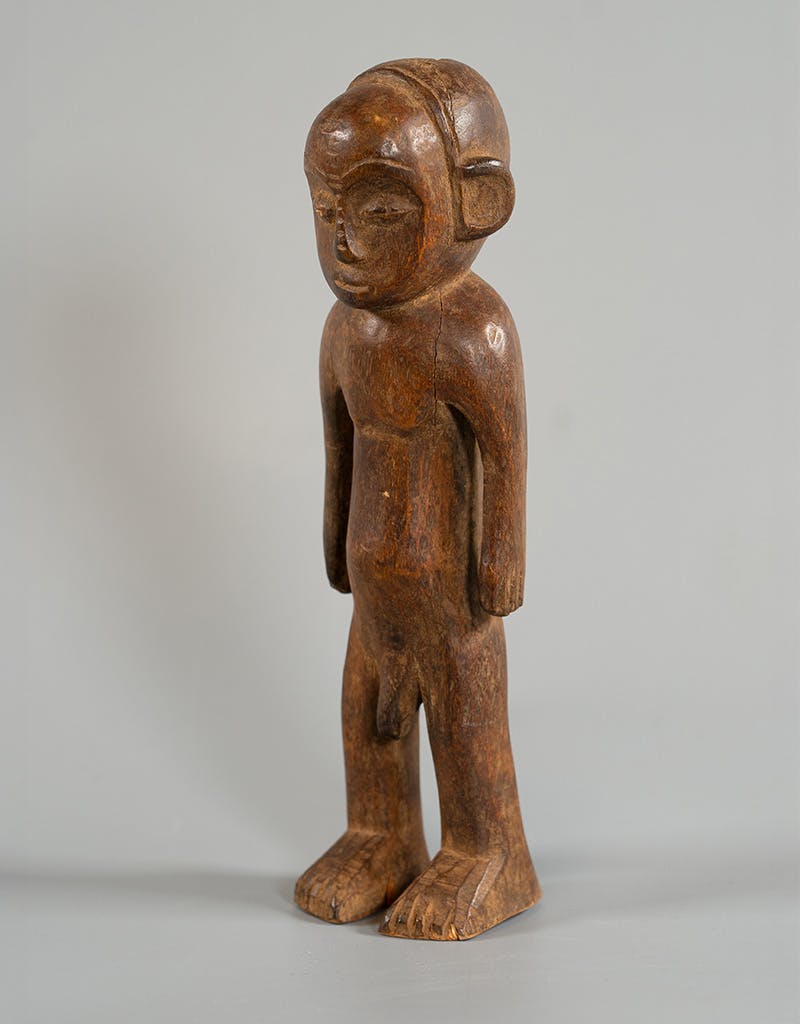


Lobala
Origin: Democratic Republic of the Congo, Sud-Ubangi Region, Enyele village
People/Ethnic Group: Lobala
Material: Wood, natural patina
Technique: Sculptural
Age: before 1950
A small male figure from the Lobala workshop — a small ethnic group of north-western Democratic Republic of the Congo (Sud-Ubangi region), inhabiting the basins of the Ubangi and Mongala rivers. Lobala art, sparsely documented in the literature, sits stylistically between the Ngombe, Ngbandi, and Ngbaka traditions — with strong simplification of mass, elongated proportions, and a pronounced vertical orientation.
The characteristic features of this figure — head with a stylised parted hairstyle, narrow, barely outlined eyes, arms held against the torso, slightly bent legs — point to a protective, most likely domestic function: such Lobala objects were placed in household compounds as protective figures of an ancestor of the lineage or founder of the village. The warm, uniform tone of the patina testifies to a long period of use.
[DRAFT — preliminary description based on visual analysis of the object and its general cultural context. Subject to verification by an expert in African art; the full catalog entry will be prepared in separate KRS documentation.]
Download PDF documentation