


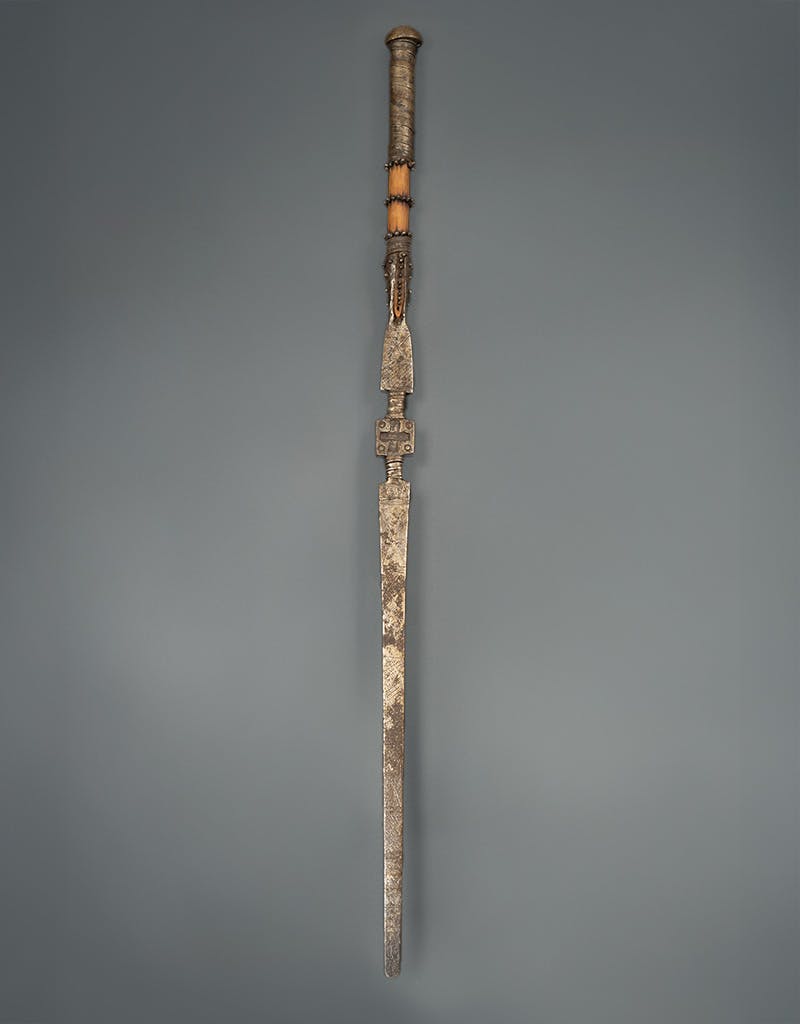


Mbele (Ceremonial Sword)
Origin: Central Africa (probably the Congo basin)
People/Ethnic Group: to be verified
Material: Forged iron, wood, plant fibres
Technique: Smithing, sculptural, binding
Age: first half of the 20th century
A short ceremonial sword with a slender, single-edged forged blade decorated with geometric surface engraving. A multi-part hilt: a cylindrical lower section wound with plant fibre, a square central connector with embedded metal studs (a cruciform sign, perhaps liturgical or clan), terminating in a smooth polished knob. Between hilt and blade is a characteristic quadrangular knot ("biscuit") — at once a decorative and a structural element.
This type of short weapon — clearly not functional in combat — served as a dignitary's insignia or a ritual object (oath, offering, ceremonial beheading). The geometric incisions on the blade recall the traditions of the smith-sculptors of the Mangbetu, Ngbandi, Bua, or Songye; a precise identification requires comparison with atlases of Congolese weaponry (Westerdijk 1988, Felix 2003).
Regional identification to be confirmed.
[DRAFT — preliminary description based on visual analysis of the object and its general cultural context. Subject to verification by an expert in African art; the full catalog entry will be prepared in separate KRS documentation.]
Download PDF documentation