


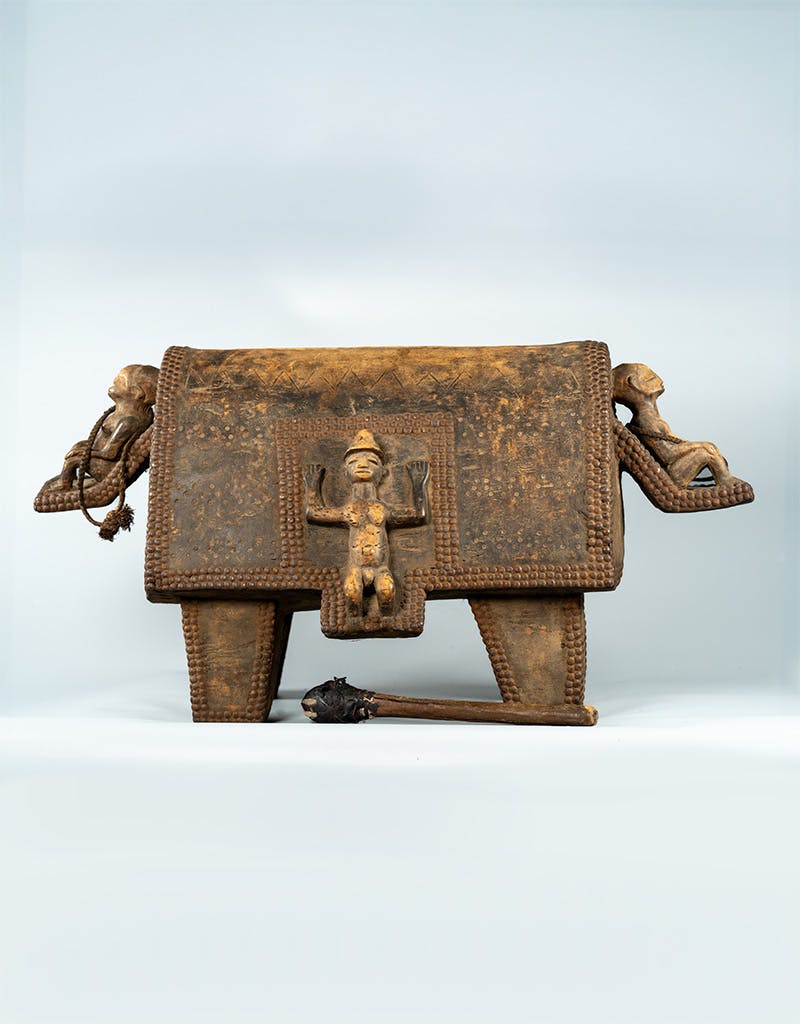


Slit Drum
Origin: Democratic Republic of the Congo
People/Ethnic Group: According to Rudi Steinmann, Holo people, Bakongo, Angola
Technique: Sculptural
Height: 43 cm
Age: circa 1950
This drum was designed and constructed by the Bakongo people of the Federal Republic of the Congo. Rhythmic refinement and acute musical sensitivity are highly refined on the African continent. Musicians identify this slit drum as an "idiophone"—an instrument that produces sound through the contact of two solid objects (in this case, hands and wood). This instrument has a narrow hole at the top with a hollow chamber that resonates when struck. In Zandi culture, slit drums often take human or animal forms. This drum is carved in the shape of a ram, a beast representing both power and stability. The Bakongo people, numbering approximately one million, currently inhabit the Democratic Republic of the Congo, the Republic of the Congo, and Angola. It should be added that the influence of the Yombe, Woyo, Wili, and Bakuba peoples is very pronounced. The Bakongo believe in a creator god who offered magical powders to the gangs and the king. This cult is practiced during royal inauguration and funeral ceremonies. It also plays a key role in magical and herbal rituals. The Bakongo are renowned for their textiles, whose aesthetic is unparalleled in Africa and is linked to the iconography of the people. Their sculptures typically depict royal wives, officials (seated figures with cross-legged positions), hunters, and musicians. Representations associated with royal funerals are particularly significant. Each successive ruler is depicted with their attributes, allowing for a chronological sequence of Bakongo rulers. Interesting objects include figurines called Pemba, depicting a woman who has lost a child but wishes to have another. This serves as a form of consolation for the loss.
Masks are relatively rare among the Bakongo. If they do occur, they are those used during initiation or funeral ceremonies.
History / Provenance:
Collection - Rudolf Steinmann
Collection - Ryszard and Joanna Stolarscy - purchased in 2023.
Download PDF documentation