


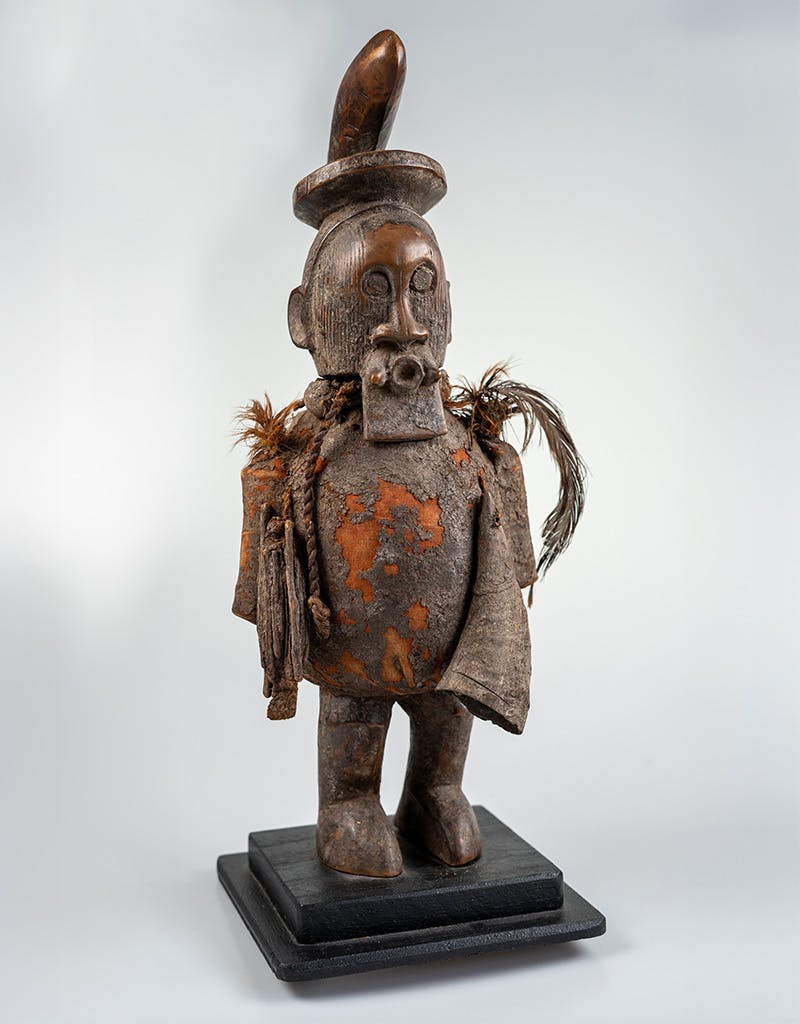


Male Biteki/Buti Power Fetish
Origin: Democratic Republic of the Congo
People/Ethnic Group: Teke
Technique: Sculptural
Height: 38 cm
Age: circa 1950
These fetishes were made in two types, and without local knowledge, it's impossible to determine which type a given figure is. The first are figurines used for good luck in hunting, called buti bumbyuu. The second, called ewo, is intended to protect against evil spells and possible retaliation by enemies. The Teke people, or Bateke, also known as Tyo or Tio, are a Central African Bantu ethnic group who speak Teke languages. Their population resides primarily in the Democratic Republic of the Congo and the Republic of the Congo, with a minority in Gabon. Omar Bongo, who served as president of Gabon in the late 20th century, was a Teke. The tribe's name reflects their occupation: trade. The word teke means "to buy." The Teke economy is based primarily on the cultivation of corn, millet, and tobacco, but the Teke also include hunters, skilled fishermen, and traders. The Teke lived in the Republic of the Congo, the Democratic Republic of the Congo, and Gabon. The mfumu was the head of the family, and his prestige increased with the number of family members. Blacksmiths played an important role in the community, and this profession was passed down from father to son. The Teke sometimes elected blacksmiths as chieftains. They believed in a Supreme Being and creator of the universe, called Nzami. However, they practiced ancestor worship only under the supervision of a diviner, the Nganga. The Teke worshiped the jinn, or nature spirits. They hoped to gain their help, and when they went hunting, they carried a small statuette with them that was believed to bring them luck.
Nganga means sage, magician, judge, or priest. A person becomes a Nganga by inheriting a position or following a dream. The Nganga possesses a statuette containing the soul of an ancestor named Tamakuwi. They can also detect witches. Ancestor worship is very important among the Teke. Ancestors live in sacred forests, near rivers, in clearings, and in caves. If descendants disrespect their ancestors, they believe they will return to torment them, whether through illness or mental illness. To avoid this, each family venerates its ancestors. This cult manifests itself in anthropomorphic statues.
History / Provenance:
Collection - Rudolf Steinmann
Collection - Ryszard and Joanna Stolarski - purchased in 2023.
Download PDF documentation