


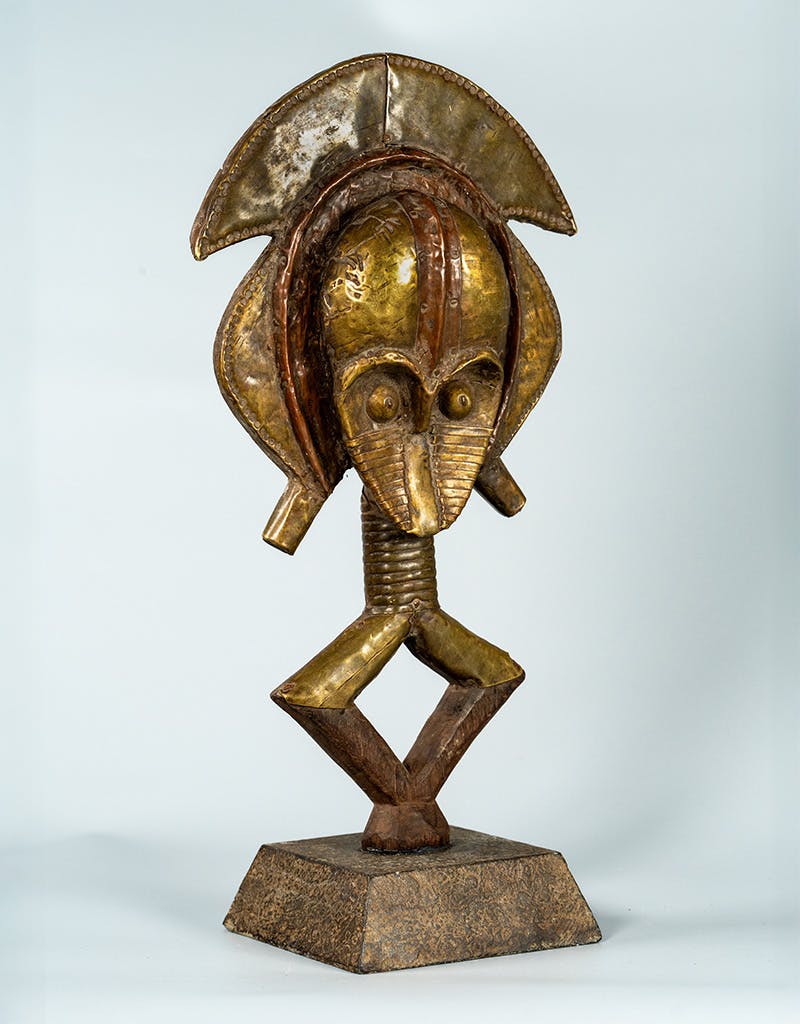


Mbulu Ngulu (Male Reliquary)
Origin: Democratic Republic of the Congo/Gabon
People/Ethnic Group: Kota
Technique: Sculptural
Height: 50 cm
Age: circa 1950
The Kota used reliquary guardian figurines (mbulu ngulu) to protect and preserve the remains and bones of family ancestors (sometimes these were personal belongings of the deceased). Artifacts were preserved in containers made of bark or plant fibers. The mbulu ngulu stood atop this bundle, tied to it at the base by a diamond-shaped figure. The entire reliquary, the figurine and basket, is called Bwiti. It is believed that the symbolic form of the mbulu ngulu was intended to amplify and convey the immense power of the reliquary. Kota mbulu ngulu are unique among African sculptural forms due to their combination of wood and forged metal. The Kota people, numbering approximately 75,000, live in eastern Gabon and the Democratic Republic of the Congo. The Kota are actually several groups of peoples with common cultural characteristics. Although these nations share many cultural traits, they are by no means homogeneous. In the rainforests surrounding the Kota, slash-and-burn techniques are used, combined with crop rotation. Shifting crops from year to year avoids erosion and soil depletion. The main crops are bananas and cassava. The Kota live in villages composed of two or more clans. Clans, in turn, are composed of several lineages or family groups descended from a common ancestor. This is an important aspect of their art, because, like the Fangs, the Kota venerate ancestral relics. Ancestor worship formed the core of the religious and social life of the family group. After the death of a chief, initiates would take various relics from the
deceased's body, which were then decorated with metal and rubbed with powders possessing various magical powers. The Kota produced a large number of ancestor statues with a diamond-shaped lower part called Mbulu ngulu; these rather two-dimensional sculptures are made of wood; to add power, symbolic metals in the form of strips or sheets were applied to the upper part. Copper, in particular, was associated with longevity and magical and vital powers. The diversity of groups scattered across a wide area led to the development of a vast variety of figurative styles, some endogenous, while others were influenced by neighboring styles. Kota figurines depict an extremely stylized human body, reduced to the shoulders and "arms," shaped like a hollow lozenge, topped by a large face framed by a lush hairstyle with hanging braids. The face, always oval, could be concave (female), convex (male), or concavo-convex, with a quarter-spherical forehead (also male). Reliquaries were kept outside homes, in huts on the outskirts of villages. Only initiates of the lineage had access to this sacred place. At the time of initiation into the reliquary cult, clans met to perform communal rituals. The chief of each clan danced while holding the reliquary. Some reliquaries featured a large figure representing the founder of the lineage and several smaller figures representing his successors. Some have figures with two identical or different faces, carved on opposite sides of a flat head. Beginning in the 1870s, Mbulu ngulu were among the first African sculptures acquired by European naturalists and explorers—among them Paul Du Chaillu, Alfred Marche, Oscar Lenz, and Pierre Savorgnan de Brazza. From the early 20th century, avant-garde artists—including Europeans such as Pablo Picasso, Fernand Léger, and Paul Klee, Americans such as Alfred Stieglitz, and Africans such as Ernest Mancoba—avidly collected Kota art and drew inspiration from it.
History / Provenance:
Collection - Rudolf Steinmann
Collection - Ryszard and Joanna Stolarski - purchased in 2023.
Download PDF documentation