


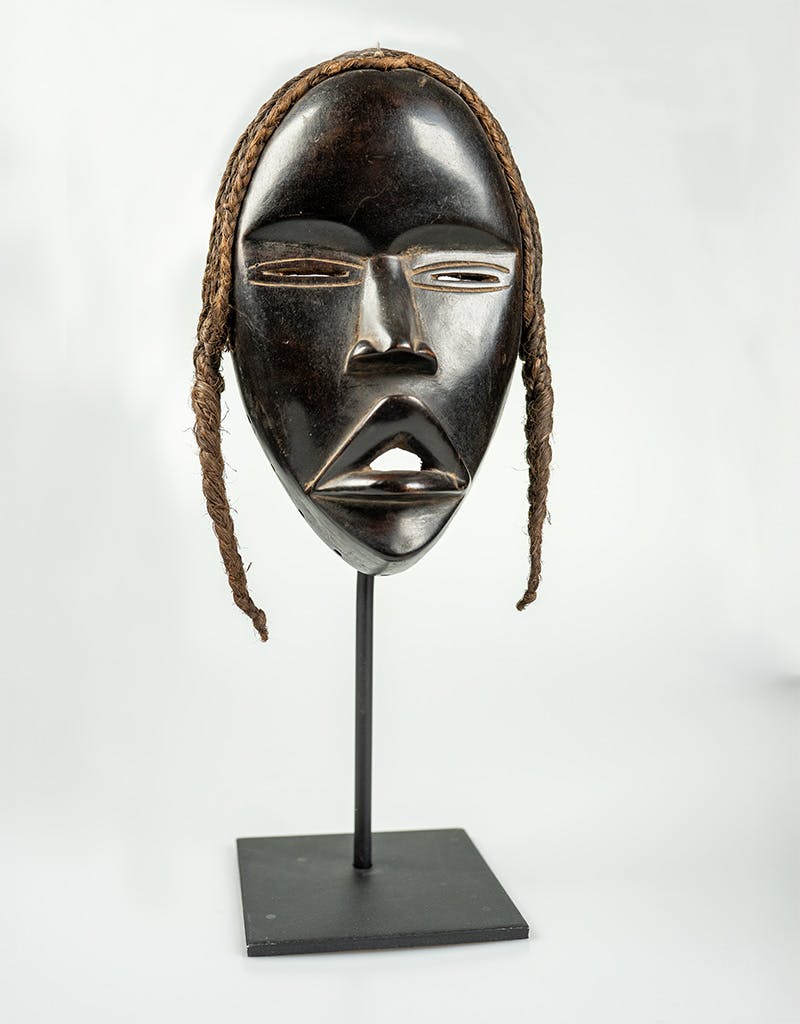


Takangle/deangle
Origin: Liberia
People/Ethnic Group: Dan
Technique: Sculptural
Height: 20 cm
Age: circa 1950
The takangle mask evokes delicate female features. Narrow (squinted) eyes and a striking hairstyle have several meanings. First, it is a mask used for entertainment, then called a takangle. A dancer wearing a takangle usually specializes in singing. Such a performer is called a gle so and serves as a support person for the dancer wearing the so-called large Dan mask, or go ge (used to settle legal disputes). This technique is intended to emphasize the role of the secret Go society, whose instruments are the aforementioned masks. The mask is called a deangle when used by messengers carrying messages between the village and the training camp for uncircumcised boys. When used as a deangle, the eyes are painted white, reminiscent of women's eyes during initiation ceremonies. White is also a symbol of joy and the realm of the dead. The facial incisions refer to the scarifications that Dan women undergo for aesthetic reasons. The prominent forehead suggests that this mask was made by the Dan from the southern territories. The Dan people number approximately 350,000 and inhabit the western part of Côte d'Ivoire and Liberia. They cultivate cocoa, coffee, rice, cassava, and fish. They are also known for their skill in all kinds of games. For centuries, they have become renowned as warriors, waging fierce wars with their neighbors from the We, Guro, and Mano peoples. The Dan have essentially no centralized authority. They are a conglomeration of villages under the rule of a village chief and a council of elders. Social and political unity is ensured by secret male societies, which establish patterns of behavior, demand loyalty and obedience from members, and ensure the introduction of boys to the adult world. Their guardian spirits are beings
residing in the bush. The most powerful of these is the leopard society known as Go, which serves as a social regulator of daily life. It initiates young boys and educates them during four- month bush camps preceding their initiations. During the initiation, which both girls and boys undergo, circumcision takes place. This ceremony is a kind of offering to the spirits inhabiting the bush (e.g., ancestors), who act as mediators between people and the supreme deity called Zran. The Dan people are famous for their festivals, or rather for their entertainment (today, they are held primarily to please visiting guests). Impressively costumed dancers dance on stilts. The costumes are issued by the master of the Go association and kept in a sacred hut. It should be noted that all their masks are sacred. The Dan believe that they do not represent the spirits inhabiting the bush, but that they are the spirits themselves. Each mask has different functions. They can serve as initiation aids, prevent bushfires, provide motivation during war ceremonies, and even celebrate peace. Above all, however, they serve as entertainment. An interesting type of Dan mask is the so-called passport mask (identification mask). These small masks, no longer than 10 cm, are attached to clothing (around the neck or waist). They serve as a type of ID card. The Dan also make statuettes, such as figurines depicting chiefs or mothers with children. These are kept in homes and used primarily for decoration and to emphasize the continuity and importance of the family. An interesting Dan custom is the making of a striking, decorative spoon for women, who are renowned for their hospitality and resourcefulness. This is related to the central role of women in village life. It is women who feed guests, musicians during festivals, and workers helping in the fields, not to mention their own men.
History / Provenance:
Collection - Rudolf Steinmann
Collection - Ryszard and Joanna Stolarski - purchased in 2023.
Download PDF documentation