


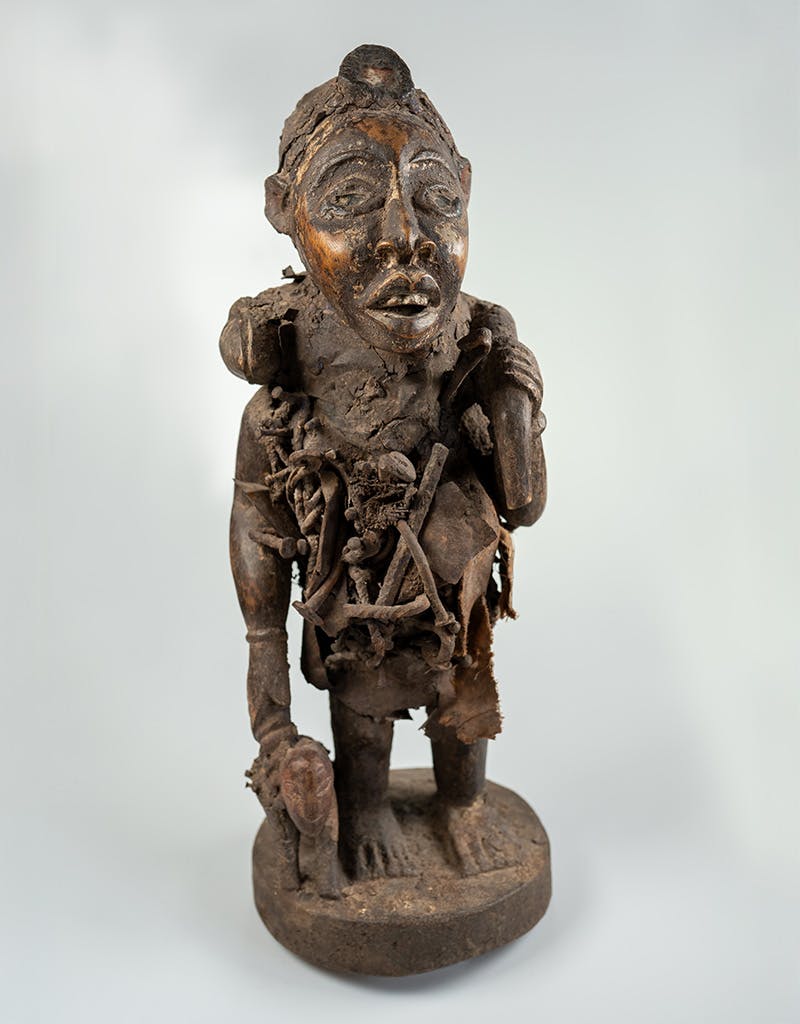


Nkishi nkondi
Age: circa 1950
Mnikisi are always made by a fortune-teller, ngagnge (sorcerer, healer), or other figure who may have a connection to the afterlife. While crafting the figurine, these individuals pray and prepare secret substances for a specific purpose. A characteristic feature of Nkisi Nkondi is the inclusion (stuck, glued, or tied) of tubes, blades, nails, strings, bones, fruit, etc. These figurines typically have a container placed in the belly or head (these body parts are considered sacred). These containers contain magical potions called bilongo. The container is usually sealed with a mirror or glass (sometimes sealed with resin). Glass is a symbol of the afterlife, a kind of eye through which the dead look to detect potential danger. The mirror is intended to deflect evil forces. Bilongo can contain various ingredients. For example, seeds are placed so that the spirit can reproduce itself. Earth (kaolin clay), most often collected from around the cemetery, represents and also summons spirits. The claws are intended to stimulate spirits to vigilance or attack enemies. A nail driven through the nganga signifies a settled matter. It's worth noting that the deeper the metal, the more serious the matter. Deeper-sewn blades can mean murder. Before driving the nail, the nganga allows clients to lick the blade so that they can "report" the matter with their saliva. Europeans first encountered these figurines in the early 15th century, but it wasn't until missionaries in the 19th century that they became seriously interested. Unfortunately, because they were considered objects of a witchcraft nature, they were destroyed. It's worth noting that the tradition of creating nkisi nkondi developed not only in neighboring parts of Africa but is present in the Americas and the Caribbean. It is still used today in voodoo, Palo, and makumba practices. The Bakongo people, numbering approximately one million, currently inhabit the Democratic Republic of the Congo, the Republic of the Congo, and Angola. It's worth noting that their influence is clearly visible among the Yombe, Woyo, Wili, and Bakuba peoples. The Bakongo believe in a creator god who offered magical powders to the gangs and the king. This cult is practiced during royal inauguration and funeral ceremonies. It also plays a key role in magical rites and the use of medicinal herbs. The Bakongo are renowned for their textiles, whose aesthetics are unparalleled in Africa and are linked to the iconography of the people. Their sculptures typically depict royal wives, officials (seated figures with cross-legged positions), hunters, and musicians. Representations associated with royal funerals are particularly significant. Each successive ruler is depicted with their attributes, allowing for a chronological order of Bakongo rulers. Interesting objects include figurines called Pemba, depicting a woman who has lost a child but wishes to have another. This serves as a form of consolation for the loss. Masks are relatively rare among the Bakongo. If they do occur, they are those used during initiation or funeral ceremonies.
History / Provenance:
Collection - Rudolf Steinmann
Collection - Ryszard and Joanna Stolarski - purchased in 2023.
Download PDF documentation