


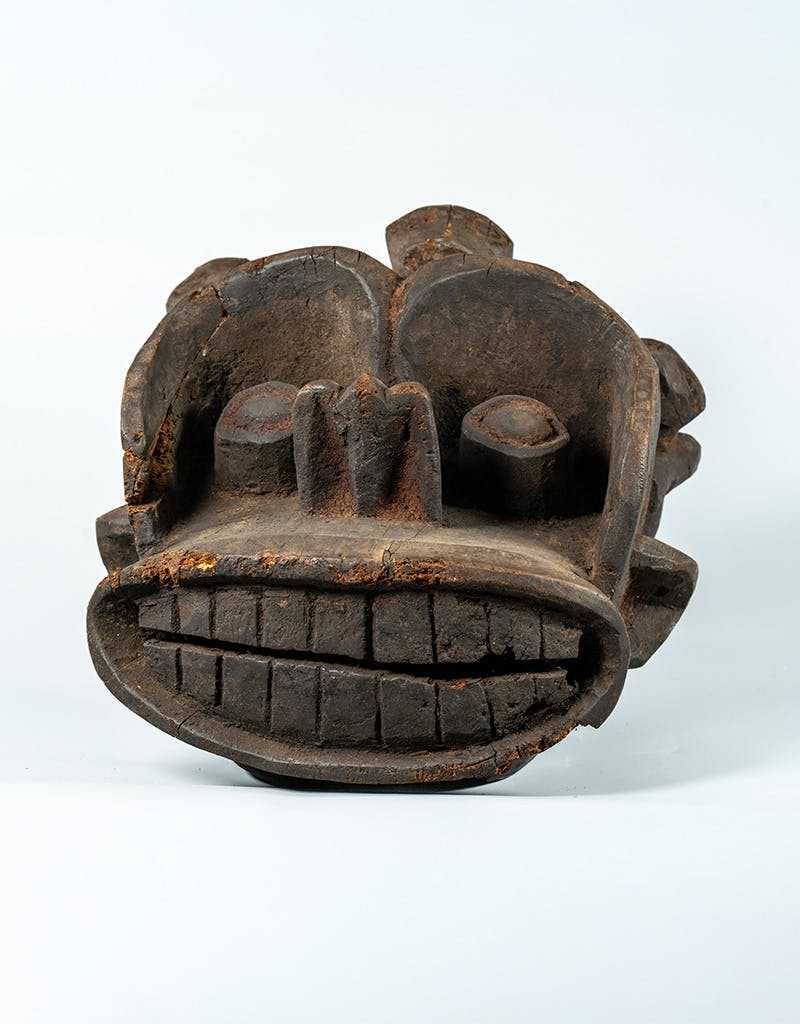


Troh
Age: circa 1950
The Bangwa people are divided into nine smaller, autonomous chiefdoms, which are governed by high-ranking members of the male Troh association, also known as the Night Association. These chiefs are called Fon. Troh members play a significant role in funerals and in the ceremonies and processes related to the appointment of a new cacique. They are also responsible for enacting and enforcing the law, including punishing criminals. Each of these notables possesses a unique mask, a symbol of their authority. Such a mask is considered exceptionally dangerous and must therefore be treated with special respect, while adhering to all ritual rules. Troh masks are usually worn on the shoulder, avoiding contact with the head. This is important to prevent the mask from taking over the wearer. Troh masks are kept in special hiding places located outside the village and are guarded by servants. Troh masks often have two faces, but there are also examples with three or four faces. They come in two styles. The former are somewhat more realistic representations, aesthetically reminiscent of the neighboring Bamileke people. The latter is more abstract and cubist. The mask described belongs to the former style. Until recently (2000), such masks could be seen in the works of Atem, a craftsman and herbal healer living in the western regions of the Bangwa. (Brian/Polllock, 1971) The Bangwa have many associations – groups of people with common status, interests, or roles, such as mothers and fathers of twins, peers, warriors, women, and recreational dance groups.
They all meet and participate in every important occasion, often presenting their own dances and ceremonies. However, the two most important associations in Bangwa social organization are the Night Association (Troh) and the Gong Association (Lefem). The Night Society is the fearsome arm of the law, the chiefs' fearsome weapon in enforcing punishment for serious crimes. The senior members of the Troh, its inner sanctum, were the Nine Servants (the chief's original companions in the origin myth). Today's Nine are powerful lords, submariners, and nobles who are descendants of princesses married to the servants. Their most important function was to rule and protect the palace during the often turbulent interregnum following the chief's death. It was to them that the chief revealed the name of his successor, and it was they who introduced the new ruler to the people (see Brain, 1971:65-83). They are often called the "kingmakers" of the Bangwa. When they appear in public, they are disguised in sackcloth and leaves, and their presence evokes a deep, fearful silence, especially when their leader, the Lord of the Night (Troh Ndi), appears. The Night Society accompanies the chief and other important members of the royal family on magical excursions, during which they transform into flying animals and feast on (imaginary) human flesh (cf. de Latour 1991: 166-170). While the Night Society is concerned about the horrific use of power, the Gong Society is somewhat more relaxed. The Gong Society, known as Lefem, which is also the name of the sacred forest where they meet, is reserved for subordinates and nobility. They meet to make offerings to ancestors, feast, play gongs (iron bells) to bless the people and the country, and discuss state affairs. Although not as secretive as the Night Society, non-members are prohibited from entering the forest during discussions, although men may enter to play gongs if their father is deceased. It is during these meetings that the carved figures of royal ancestors are brought into the light. The statues are intended to make the ancestor present and embody the ancestor. Ultimately, the Gong Society is a place where decisions and policies regarding village life are made in consultation between the living and the dead (Brain 1971: 84). This represents the positive side, primarily the power and corporate nature of Bangwa social organization. Like the Bamileke, the Bangwa recognize Si (the supreme god), but more often pay homage to their ancestors. Ancestral spirits are embodied in the skulls of deceased ancestors. The skulls are in the possession of the oldest living male in each lineage, and all members of the extended family consider them a shared heritage. When a family decides to move, a dwelling is built, which must first be cleansed by a diviner to accommodate the skulls in the new location. Although not all ancestral skulls are in the possession of the family, the memory of all ancestors is honored. Ancestral spirits whose skulls are not preserved have nowhere to hide and can cause trouble for the family. To compensate for the lack of a male skull, a family member must undergo a ceremony during which libations are thrown into the ground.
The earth collected from the sacrifice site then represents the skull of the deceased. Respect is also paid to women's skulls, although details of such practices are largely unrecorded.
History / Provenance:
Collection - Rudolf Steinmann
Collection - Ryszard and Joanna Stolarski - purchased in 2024
Download PDF documentation